

Why Waiting for Rescue Fails, and How to Change Your Relationship With Your Inner Critic
I didn’t start to get well until I realized something uncomfortable but freeing.
The cavalry wasn’t coming.
I could recover from my eating disorder.
I could take medication.
I could do years of CBT, DBT, trauma work, and somatic practices.
And still, no therapist was going to evict my dad, my shame, or my internalized misogyny from my brain.
No amount of medication or meditation was going to stop my mind from generating the same old thoughts.
That realization didn’t break me.
It freed me.
When Therapy Helps, But the Noise Stays
Let me be clear: therapy helped me enormously.
Eating disorder treatment helped me stop the behaviors.
Trauma therapy helped me discredit my father’s worldview.
Feminist education helped me understand how culture shaped my self-perception.
And yet, the noise remained.
The commentary didn’t disappear just because I understood where it came from.
This much therapy and you’re still fucked up?
You’re lazy.
Who do you think you are?
Maybe you’re a hopeless case.
If you’ve ever wondered why your inner critic is still loud even after years of personal growth, you’re not alone.
Understanding the origin of a thought does not automatically stop your brain from producing it.
What Is “Noise,” Really?
When I talk about noise, I’m not talking about casual self-talk.
Noise is the mental commentary driven by fear and shame.
It’s the internal survival system doing its job a little too well.
Noise:
Monitors you constantly
Evaluates your worth
Anticipates rejection
Tries to keep you “safe” by controlling you
For many of us, this voice developed early in life as a way to:
Stay connected to caregivers
Avoid punishment or abandonment
Manage chaos or unpredictability
At one point, it may have protected you.
But survival strategies have expiration dates.
What starts as protection eventually becomes policing.
How Inner Critic Noise Shows Up
While everyone’s noise sounds different, the themes are remarkably consistent.
Noise often sounds like:
“What if I fail again?”
(Inventing crises that don’t exist yet)“I can’t say no, that would be disloyal.”
(Forcing compliance to identities you’ve outgrown)“Everyone is judging me.”
(Projecting internal shame outward)“I have to be perfect before I show up.”
(Using impossible standards to avoid imagined rejection)“I can’t ask for help, I’ll be a burden.”
(Taking responsibility for other people’s feelings)
The common denominator beneath all of it is fear and shame.
Not truth.
Not intuition.
Not intelligence.
Why Trying to Silence the Noise Backfires
The wellness and self-optimization industries love to sell us the fantasy that we can eliminate negative self-talk.
When that doesn’t work, we blame ourselves.
We assume we:
Didn’t try hard enough
Did the work “wrong”
Need a better protocol
This keeps us stuck in a loop of self-improvement that quietly reinforces the same message:
Something is wrong with you.
That’s when I realized something had to change.
Not the noise.
My relationship to it.
Grieving the Fantasy of Silence
One of the hardest parts of this work was grieving.
I had to grieve:
The fantasy of a quiet mind
The idea that healing meant “no more noise”
Who I thought I could be without it
I had to accept that my brain might continue producing the same thoughts indefinitely.
And paradoxically, that acceptance is what reduced my suffering.
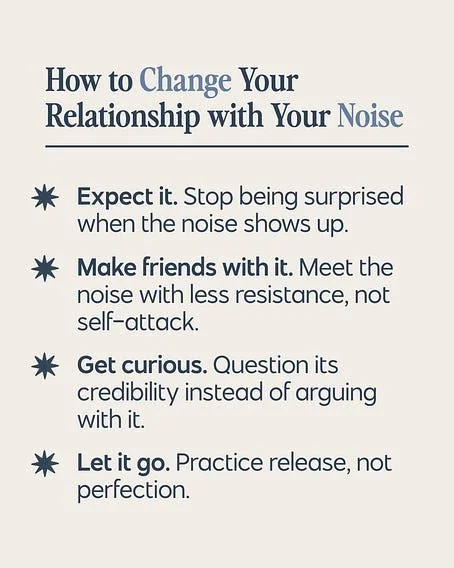
How I Changed My Relationship With My Inner Critic
Here’s what actually helped.
Not eradicating the noise.
Not arguing with it.
Not trying to be better than it.
1. Expecting It
I stopped being shocked when the noise appeared.
Given my history, it would be strange if it didn’t.
Expecting the noise doesn’t mean obeying it.
It means acknowledging its presence without treating it like an emergency.
2. Making Friends With It (Not Celebrating It)
I stopped attacking myself for having the thoughts.
I practiced seeing the noise as a wound, not a moral failure.
Sometimes that looked like humor.
Sometimes compassion.
Sometimes a quiet internal “ah, there you are.”
Less resistance meant less suffering.
3. Getting Curious Instead of Credulous
I stopped asking, “How do I get rid of this?”
And started asking:
Is this biased?
Is this fear talking?
Would someone who loves me agree?
Curiosity loosens identification.
I remembered: this isn’t me.
4. Practicing Letting It Go (Not Perfectly)
Letting go is a practice, not an outcome.
I still get hooked.
I still believe the noise sometimes.
I still spiral occasionally.
That’s not failure.
That’s being human.
The Hard Truth No One Wants to Hear
There is no pill, protocol, or modality coming to silence the noise forever.
The cavalry isn’t on its way.
You are.
Not because you’re broken.
Not because you failed therapy.
But because this work can’t be outsourced.
Freedom doesn’t come from eliminating the voice.
It comes from learning how to stand your ground internally.
That’s where real relief lives.
A Gentle Invitation
If you’re open to reflecting, ask yourself:
What does your noise reliably say when it shows up?
Naming it is often the first step in loosening its grip.
If this essay spoke to you, I’m currently turning these practices into a small, practical workbook you can return to when the noise is loud. Not to get rid of it, but to relate to it differently in real time.
Hi, I’m Mollie
I’m Mollie Birney. I’m a clinical coach, former therapist, and a devoted explorer of what it means to get free from our internal noise.
I work with people who are thoughtful, self-aware, and deeply invested in their growth, and who are also exhausted from trying to “fix” themselves. People who’ve done therapy, read the books, learned the language, and are still wondering why the voice in their head hasn’t quieted yet.
My work isn’t about silencing your thoughts or turning you into a more optimized version of yourself. It’s about helping you build a steadier, kinder relationship with your inner world so you can stop outsourcing your sense of safety to perfection, productivity, or approval.
I don’t write or teach from a pedestal. I write from the desk next to yours in this strange classroom we’ve landed in together.
