

The Problem With Affirmations: When Positive Thinking Turns Into Self-Abandonment
Why affirmations don’t work for everyone, and what actually helps build self-trust instead.
Affirmations have always made me queasy.
Maybe it’s because I first encountered them in eating disorder treatment, when my self-worth was tanked and shame was running the show. Before each meal, we were required to pull a card from a painfully optimistic affirmation deck, and read it aloud to the table.
I am magnetic and worthy of love.
Everything is working out for my highest good.
I choose positivity in every moment.
The words curdled in the acid of our collective cynicism and self-doubt. We read them in robot voices, accents, lisps, anything to buffer how foreign and invasive they felt in our nervous systems.
I wrote in my journal:
“Ew. Now I want to barf before and after dinner.”
What bothered me wasn’t the optimism itself. It was the forced incongruence, the ritualized overriding of my internal reality, paired with the suggestion that doing so was therapeutic.
And that’s the problem with affirmations, no one really talks about.
Why Affirmations Don’t Work for Everyone
I wasn’t opposed to positive self-talk. I obviously had work to do in that department. But in a very literal way, affirmations felt hostile to my nervous system.
The closest comparison I can think of is being forced to recite the Lord’s Prayer in church when I knew I didn’t believe.
What even are these words?
Who talks like this?
What am I actually saying?
Affirmations often ask people who are steeped in shame to override their lived experience instead of listening to it. And for many nervous systems, that doesn’t build safety; it erodes it.
The Affirmation That Actually Helped Me Heal
So I made my own affirmation. One that matched where I actually was.
“I hate myself, but it doesn’t have to stay that way.”
I offered it quietly one morning at breakfast. Heads nodded. No eye-rolling. No resistance.
And it worked, not because it was positive, but because it was true enough.
There was nothing syrupy to push against. No inner critic to fight. My nervous system could stand inside those words. They acknowledged my reality and implied impermanence.
I couldn’t tolerate self-love yet, but I could tolerate the possibility that things might change.
That mattered.
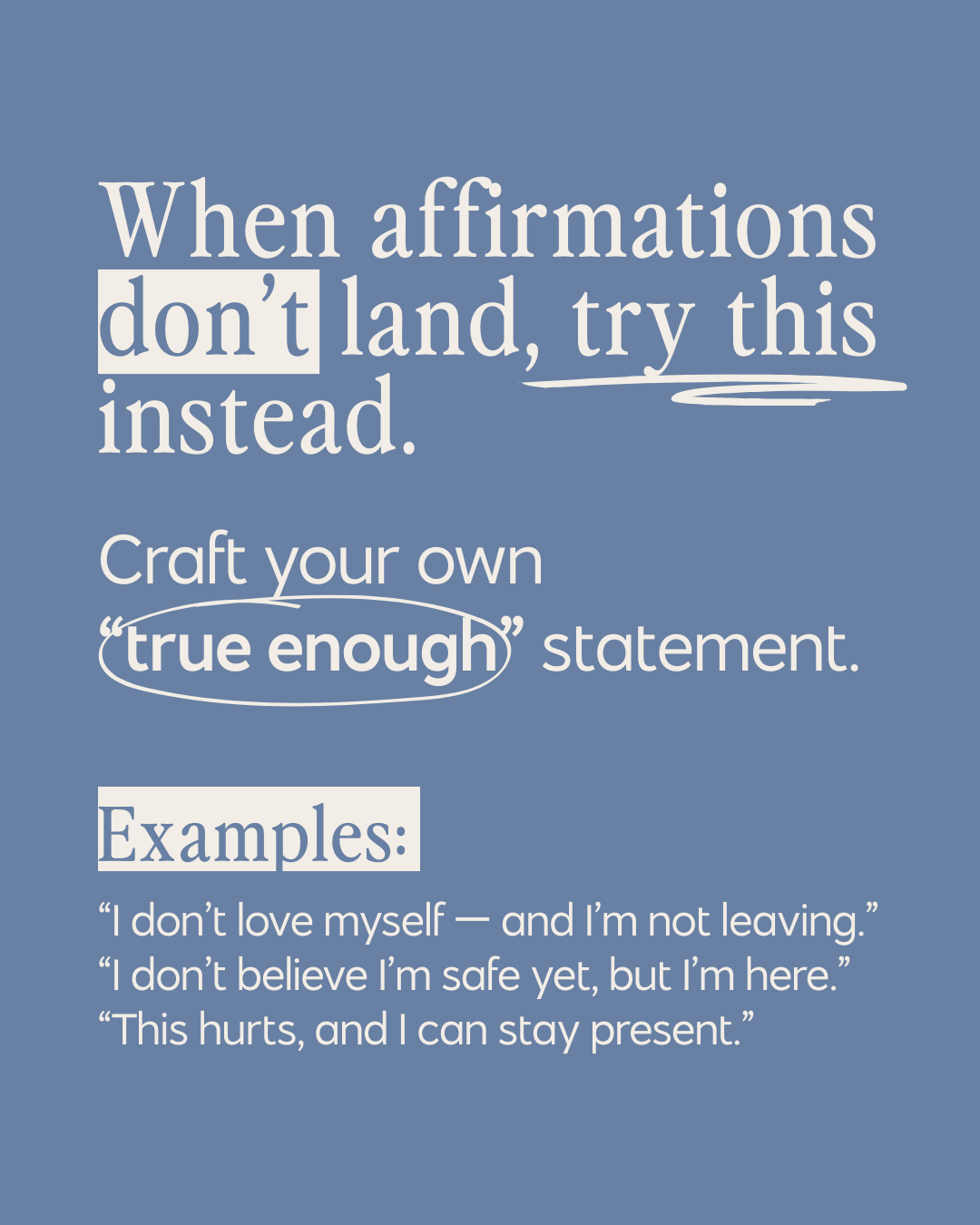
Nervous System Truth vs. Positive Thinking
At the time, I knew enough to be suspicious of my resistance. In treatment, we’re taught that if something triggers you, you work on yourself, not the trigger.
And yes, my allergy to positivity made sense given my history with shame.
But intuition told me something else was going on. And years later, with a clinical psych degree, eight years of private practice, and a nervous system that actually feels safe, I understand it more clearly.
Affirmations often bypass the work that healing requires.
They focus on the script of the outcome instead of the nuance of the process. They skip over:
Curiosity
Resistance
Attunement
Nervous system consent
From a clinical standpoint, that’s not how trust is built.
We don’t start with belief.
We start with doubt.
We start where we are, not where we think we should be.
Any practice that asks someone flooded with shame to declare “I am worthy of love” without first understanding why that feels threatening is likely to land as invalidating, or even self-abandoning.
Why Forced Affirmations Can Erode Self-Trust
My DIY affirmation worked because it didn’t demand belief.
It invited relationship.
When affirmations are forced, we train ourselves to override our internal reality. Over time, this weakens self-trust and dulls our ability to listen to somatic feedback.
And if you really think about it, affirmations often point directly to where we aren’t.
Affirming worthiness from a place of unworthiness doesn’t close the gap; it spotlights it.
It reinforces the problem instead of resolving it.
Healing Is More Than Positive Self-Talk
If affirmations work for you, truly, that’s wonderful.
But if they don’t, I want you to hear this clearly:
You are not broken. You are not resistant. And you are not doing healing wrong.
You cannot bully your nervous system into safety by shouting compliments at it.
Healing isn’t about correcting or micromanaging your thoughts. It’s about changing your relationship to them. Learning how to stay present with doubt, shame, and resistance long enough for trust to grow.
So if affirmations make your stomach turn, listen to that.
It might not be resistance.
It might be discernment.
The most healing “affirmation” I’ve ever practiced worked because it told the truth without abandoning me.
And that’s still what healing asks of us.
Not prettier thoughts.
Not louder positivity.
Just the courage to meet ourselves honestly, and stay.
Want Support Building a Kinder Relationship With Your Mind?
If affirmations have never worked for you, you’re not alone, and you don’t need to force them.
I specialize in helping people:
Build trust with their internal world
Work with shame and inner noise without self-attack
Create nervous-system-safe practices that actually stick
Explore Get Unstuck, a self-guided course for practical tools to meet yourself honestly, without bypassing or bullying your experience.
-Mollie Birney
