

Loss of Identity in Motherhood: What Happens When You Stop Fighting the Change
I've been a mom for five years. But only now, in this fifth year, am I finally catching my breath.
If you're reading this because you Googled something like "losing myself in motherhood" or "who am I now that I'm a mom", I want you to know: I wrote this for you. Because I spent four years in exactly that fog, white-knuckling my old identity while motherhood quietly dismantled it, piece by piece.
And I'm a Clinical Coach. I know the theory. It didn't matter.
The Rubric That Was Wrecking Me
For the first four years of my son's life, my measure of success as a mother had almost nothing to do with him.
I didn't track it by how connected we were. Not by how loved and nourished he felt, or how he hit his developmental milestones, or how my husband and I were growing into new parenthood together.
I measured my success as a mother by how little I could manage to be changed by it.
Before giving birth, I literally wrote an article about my resistance to motherhood called "Not Like Those Other Pregnant Women." I wanted to be a mom; we very much wanted a child, but I dreaded what motherhood culturally promised: a complete loss of self. Loss of mobility, creativity, productivity, sex appeal, and relevance. Loss all the way down.
The whole piece could be summed up as: But I, unlike all those fools, will not lose.
My feminist leanings had crashed into my anxiety and internalized misogyny and produced an ambitious control freak who was terrified of being undone by her own maternal instincts.
Clinging to the Old Self (And What It Cost Me)
Once my son arrived, I decided every metric by which I'd measured my worth had to remain intact. My work ethic. My creativity. My body. My income. No change.
I took two weeks of maternity leave from my private practice. I was back on the yoga mat within two days of giving birth. I was sending invoices and writing articles while breastfeeding. I am a liberated woman, and I will not be held back. What I couldn't see then was that only terror can drive someone to cling that fiercely to a version of themselves they're so clearly outgrowing.
A few months in, I literally couldn't spin all the plates I once had. My brain fog left me clumsy and uncreative. I was too tired, too scattered, too stretched-thin to feel useful. Most of all, I was deeply angry at myself for not sustaining the successful self I'd worked so hard to build.
The loss of identity in motherhood that I'd feared and dismissed as something that happened to other women, less capable women, was happening to me.
I held my son close. And I refused to grieve who I had been.
Intellectualizing as a Survival Strategy
For the first few years, I limped through by intellectualizing the whole thing. I adored my infant, my toddler, my sweet boy, but the mothering, the verb of it, was costing me so much that the only way I could participate was by stuffing my heartbreak and framing it as service. As dharma. As something noble.
I repeated Ram Dass' words to myself like a mantra: You can do it like it's a great weight on you, or you can do it like part of the dance.
"Part of the dance, part of the dance, part of the dance," I whispered to myself while folding laundry, soothing tantrums, and waking at 3 am to change the sheets on a wet bed.
These spiritual reframes helped me make sense of a choice we'd made very intentionally. But they also helped me avoid how humiliating it felt to no longer know who I was. To feel my IQ plummet. To feel sucked dry of every creative impulse and every last drop of energy.
Not to mention: nobody had prepared me for the emotional toll of saving your child's life every single day, as they unknowingly put themselves in danger in increasingly creative ways. Sustained hyper-vigilance sunk my battleship. And it was impossible to feel competent when the bar never stopped moving.
The Real Cost of Staying Disconnected
Here's what I eventually realized: treating motherhood as a role I was playing was the only way I could participate without burning it all down. But it was also deeply dissociated.
I was parenting from the witness mind (observational, regulated, functional) and in that distance, somehow absent. My son was getting my time and my love. But he wasn't getting my tender parts. He deserved to impact me. And he deserved a mother who had actually grieved the woman she used to be, instead of one who kept trying to reassemble her from old fragments.
The loss of identity in motherhood is real. What I didn't understand was that the grief of it was necessary, and that on the other side of that grief was something I couldn't access any other way.
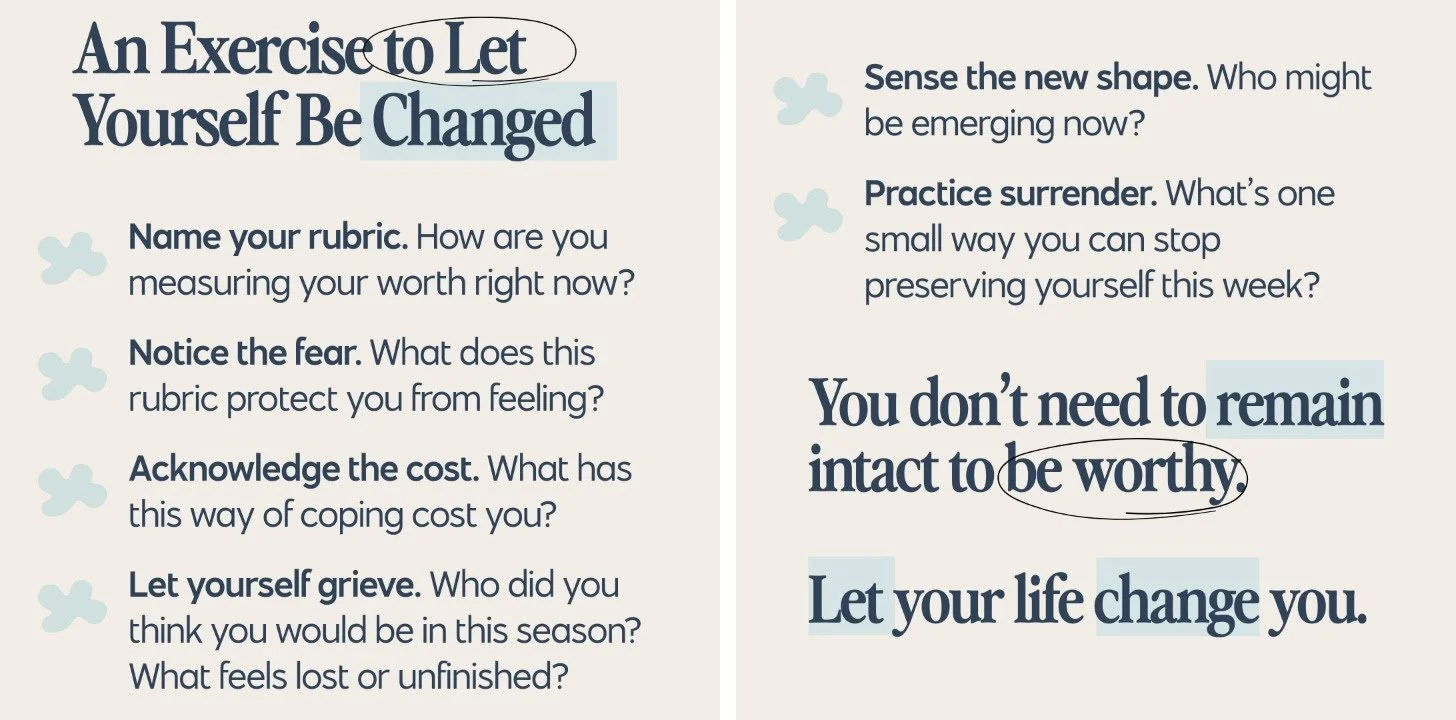
What Surrender Actually Looks Like
So I surrendered.
I leaned into the feeling of loss. I let my ego understand who I would no longer be, so I could create from who I was now, instead of stitching myself back together from pieces I thought made me worthy.
Somewhere along the way, I had confused feminism with immunity. As if being a liberated woman meant I should be untouched by the very transformation I had chosen. It felt like a dangerous bet to trust that this new iteration of myself would be enough.
But when I made it, when I finally chose to bet on who motherhood was making me, it was like surrendering in service of my own life.
What the Fifth Year Actually Feels Like
Now, in my fifth year of motherhood, the other areas of my life (my career, my creativity, my friendships, my body) are all finding their new shape. And my relationship to them has fundamentally shifted. Rather than those things constituting my identity, they feel like places to show up and serve. Not from martyrdom, but from something closer to joy. The loss of identity in motherhood was real. I'm not going to tell you it wasn't, or that it shouldn't hurt, or that you're doing it wrong if you're struggling.
What I will tell you is this:
What if the game isn't to remain unchanged? What if it's to be absolutely obliterated so that you can create yourself again?
A Question to Sit With
The loss of identity in motherhood isn't a sign that something has gone wrong. It's a sign that something real is happening; that you are being asked to grow in a direction you can't fully control or predict. And that is terrifying, especially for those of us who built our sense of worth on competence, productivity, and knowing exactly who we are.
But here's what five years has taught me: the grief isn't the enemy. The resistance to the grief is.
When we fight the loss, when we cling to the old version of ourselves and refuse to let motherhood touch us, we end up parenting from a distance. Present in body, absent in heart. And our children and we feel that gap, even when we can't name it.
Surrender isn't giving up. It isn't losing. It's making room.
So I want to leave you with this: Have you experienced a role, a season, or an identity that required you to grieve who you were to become who you are now? Are you in the middle of that grief right now, still clinging, or have you found your way to the other side of it?
-Mollie Birney
I'm Mollie Birney, Clinical Coach and former therapist, writing and working from the desk right next to yours in this strange classroom we all landed in together.
If this resonated, you might also love The Overthinker’s Workbook or…
